
CNC Mill-Turn Parts for RF Equipment: Complex Geometry, Process Selection, and Manufacturing Logic
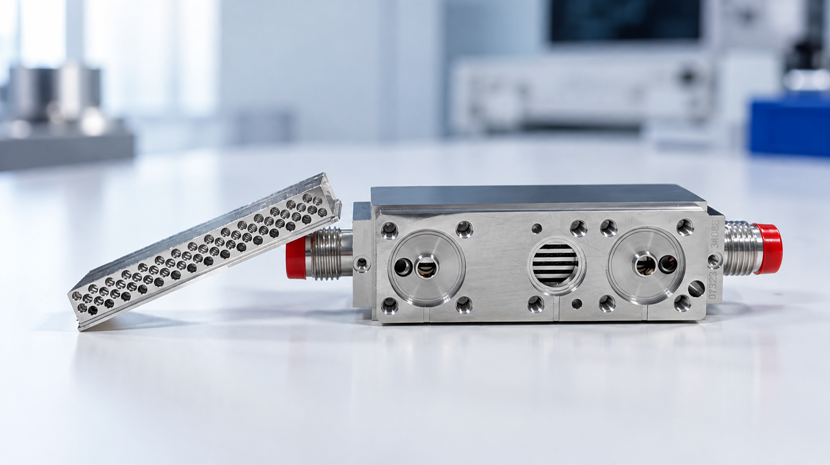
CNC Mill-Turn Parts for RF Equipment: Complex Geometry, Process Selection, and Manufacturing Logic
1. Why RF Equipment Needs Custom CNC Parts
RF and microwave equipment must match specific electrical architectures, connector types, and installation spaces. Standard parts can't cover every application. Custom CNC machining is typically used for:
-
RF and microwave structural components
-
Connector bodies, machined housings
-
Mounting blocks, adapters, interface components
-
Test fixture components
-
Brackets and supports
-
Conductive and structural connectors
-
Custom mechanical parts for electronic test equipment
These parts come with clear engineering drawings and 3D CAD models. Material, tolerance, surface roughness, and surface finish are all defined by final assembly requirements. Their value isn't in size — it's in whether they reliably deliver the interface and assembly relationships the design demands.
2. Complex Geometry ≠ Ultra-High Precision
3. Mill-Turn: Combining Multiple Features into One Process
For parts with both rotational and milling features, CNC mill-turn machining offers clear advantages.
Traditional workflows move parts between a lathe and a machining center. Turning handles OD, ID, faces, steps, threads, and cylindrical interfaces. Milling handles flats, grooves, hole patterns, cavities, non-circular profiles, and multi-face structures. When these features exist on the same part, frequent equipment changes and re-fixturing add significant process complexity.
Mill-turn delivers four key benefits:
-
Less re-fixturing: fewer repositions means better positional relationships between features
-
Simplified workflow: less transfer and waiting between machines
-
Better repeatability: a stable process route supports consistency in both small batches and ongoing production
-
Handles complex geometry: ideal for parts combining turning, milling, drilling, and threading
But one thing is clear: mill-turn is not the right choice for every part. Simple parts are often fine with traditional turning or 3-axis milling. Process selection should be driven by part geometry, not by machine axis count.
4. What Multi-Axis Machining Actually Solves
5-axis CNC machining is often simplified as "higher precision." From a manufacturing engineering perspective, its real value is machining freedom.
When a part has multiple angled faces, complex curves, deep pockets, or hard-to-reach areas, multi-axis machining changes the relative angle between tool and workpiece, letting the tool approach from a better direction. This leads to:
-
Less re-fixturing
-
Better tool accessibility
-
Fewer complex fixtures
-
Higher efficiency on complex geometry
-
Better coordination between multiple machined faces
Axis count, dimensional accuracy, and part complexity are three separate concepts. 5-axis doesn't automatically mean high precision — a key principle in process selection.
5. Material Selection: By Function, Not by Habit
Material choice for RF and electronic parts must balance mechanical strength, weight, conductivity, thermal performance, corrosion resistance, and surface treatment requirements.
Aluminum
6061-T6 is one of the most common alloys in CNC machining — good machinability, low weight, balanced mechanical properties. 7075 and other high-strength alloys are used for higher-load structures. Typical applications include RF structural parts, machined housings, mounting blocks, supports, connection structures, and test equipment parts.
Brass
Good machinability and conductivity, commonly used for connectors and interface parts.
Copper
High conductivity and thermal transfer, used in specific electronic, RF, and thermal management applications. But copper machines very differently from aluminum — tooling and cutting parameters must be adjusted accordingly.
Stainless Steel
304 and 316 suit applications requiring mechanical strength, corrosion resistance, or environmental durability.
6. Surface Treatment Is Part of Manufacturing, Not a Final Add-On
For RF and electronic parts, surface treatment affects not just appearance, but corrosion resistance, wear resistance, electrical contact, and assembly dimensions.
Common treatments:
Aluminum: anodizing, hard anodizing, chemical conversion coating, electroless nickel plating
Stainless steel: passivation, electropolishing, polishing
Copper and brass: nickel plating, gold plating, silver plating, tin plating
For parts with electrical contact, grounding, or conductivity requirements, surface treatment must be considered at the design stage. Some areas need good conductive contact; others need corrosion or wear protection. Different surfaces may require different treatments.
Platings and coatings also affect final dimensions. For holes, shafts, threads, and mounting faces with precise fit requirements, dimensional changes after surface treatment must be calculated in advance.
7. The Entire Manufacturing Chain Determines Success
Whether a part can be produced consistently doesn't depend on the CNC machine alone. From drawing to finished product, the chain typically runs:
Material → DFM → Workholding → Machining → Deburring → Surface Treatment → Inspection → Assembly
Any weak link affects the final result.
-
DFM: tool accessibility, internal corners, groove width, hole depth, machining datums
-
Workholding: stable positioning for complex parts without affecting critical surfaces
-
Machining: proper sequencing of roughing, semi-finishing, and finishing
-
Deburring: small holes, threads, grooves, and cross-machined areas are especially prone to burrs
-
Surface Treatment: account for its impact on dimensions, appearance, and functional faces
-
Inspection: verify critical dimensions, position, threads, surface roughness, and appearance
A qualified CNC supplier doesn't just "machine to drawing" — it understands the functional requirements and manufacturing logic behind the drawing. For projects involving enclosures, brackets, or mounting plates, the bend accuracy and springback control of a sheet metal bending service directly affect final assembly.
8. Tighter Tolerances Aren't Always Better
In CNC manufacturing, applying tight tolerances to every dimension drives up machining, inspection, and production costs — without necessarily adding real value to the product.
A more rational approach is to distinguish:
-
Critical dimensions
-
Functional fits
-
Interface dimensions
-
General dimensions
-
Cosmetic surfaces
Concentrate tight tolerances where they actually affect function and assembly. This is where DFM review proves its worth: if a supplier can identify which dimensions need strict control and which can use standard tolerances during quoting and engineering review, it can strike a better balance between function, quality, and cost.
9. Complex CNC Parts vs. High-Precision CNC Parts
For electronics, RF, test, and industrial equipment customers, CNC part requirements are never uniform.
Some parts focus on structural strength, assembly relationships, surface quality, and batch consistency. Others demand stricter dimensional tolerances, geometric tolerances, coaxiality, flatness, surface roughness, and precision assembly.
Complex CNC parts and high-precision CNC parts aren't mutually exclusive — they represent different manufacturing needs based on product function.
Truly mature manufacturing capability isn't about calling every part "high precision." It's about selecting the right equipment, process, tolerance, and inspection method for each part's actual requirements.
10.Excelsior's CNC Manufacturing Capability
Excelsior Hardware & Plastic Co., Ltd. has provided custom metal component manufacturing for electronics, communication, industrial equipment, and other OEM customers since 2006.
-
CNC Milling
-
CNC Turning
-
CNC Mill-Turn Machining
-
5-Axis CNC Machining
-
Precision CNC Components
We also integrate laser cutting, sheet metal fabrication, stamping, bending, surface treatment, and assembly to provide more complete manufacturing support for complex OEM projects. Whether the requirement is custom CNC machining China or supporting precision sheet metal fabrication and sheet metal bending service, we start from 2D drawings or 3D CAD models and perform DFM evaluation on material, structure, machining method, tolerance, and surface treatment.
For RF, microwave, electronic test, and communication equipment parts, we focus on machining stability and batch consistency for standard complex CNC parts. For precision CNC components with strict dimensional and geometric tolerance requirements, we develop machining and inspection plans based on specific engineering requirements.
We see ourselves as an extension of our customers' engineering and design teams. We don't just manufacture to spec — we use value engineering and process optimization to help products advance further in manufacturability and real-world performance. Your specifications are our minimum standard. Exceeding customer expectations is the principle we never compromise on.
Conclusion
CNC parts in RF equipment are often small, yet they combine multiple machining features and assembly requirements. Manufacturing quality isn't reflected in whether one dimension meets tolerance — it's reflected in structural understanding, process planning, workholding, surface treatment, inspection, and batch consistency.
CNC turning, milling, mill-turn, and 5-axis machining aren't competing methods. They're different manufacturing paths for different part geometries.
For sourcing and engineering teams, the real question isn't how many machines a supplier owns. It's:
Does the supplier understand your part, plan the process rationally, and consistently turn design into a conforming physical product?
That is the value Excelsior aims to deliver through CNC component manufacturing for RF, electronics, communication, and industrial equipment customers.
Worry-Free, Effortless: Excelsior's One-Stop Assembly and Packaging Delivery
From Concept to Reality: Excelsior's Comprehensive ODM Solutions for Enclosure Systems
